


Copyright © 2025-2028 Toffs (Shandong) Machinery Equipment Co., Ltd All Rights Reserved 鲁ICP备2025142590号-1
The Differences Between Planetary Wok and Multi-Claw Wok
2025-07-05 16:56:46View:
The Differences Between Planetary Wok and Multi-Claw Wok
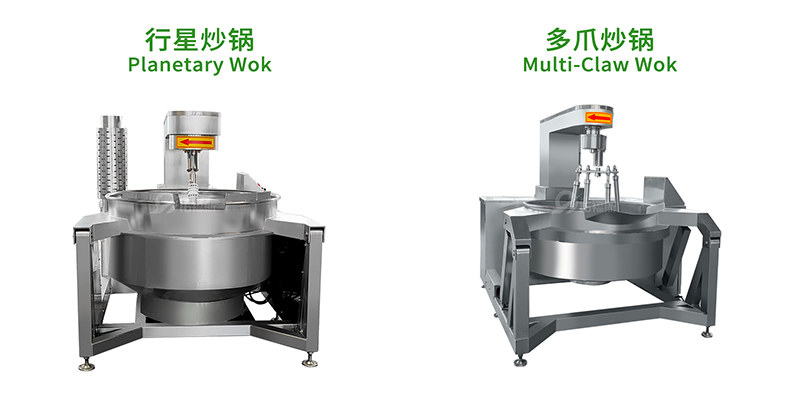
Stirring Form
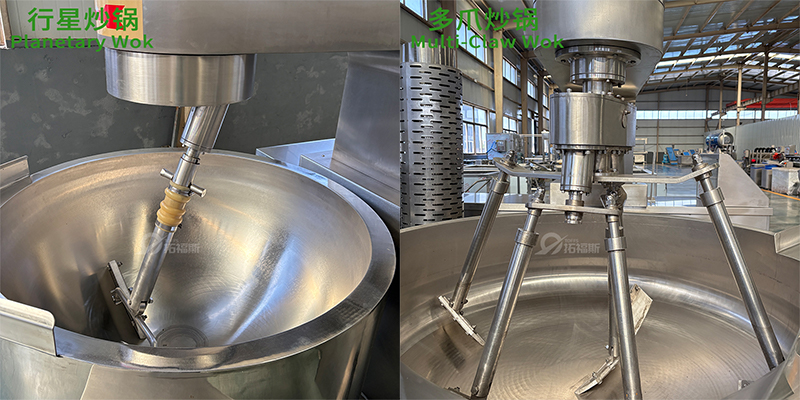
Planetary Wok: Adopts a stirring form of planetary rotation plus revolution, performing irregular stirring movements. This enables the spatula to mimic the up-and-down frying motion of manual cooking within the spherical pot body, making the materials heat more evenly.
Multi-Claw Wok: Adopts a reciprocating translating as "circulating" motion, which can only push the materials to move forward in a circulating motion within the pot, without a frying effect.
Stirring Spatula
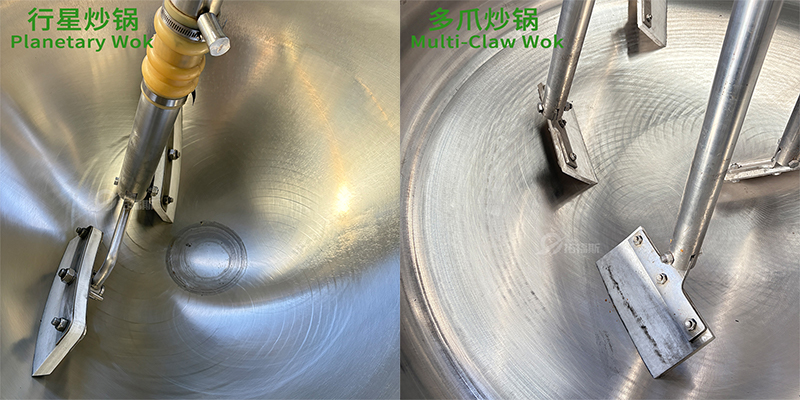
Planetary Wok: The stirring spatula is perpendicular to the pot body, with greater force at the spatula bottom, resulting in a better bottom-scraping effect.
Multi-Claw Wok: The stirring spatula has an angle and needs to be used with a scraper to shovel out the materials.
Distribution of Stirring Shaft Elastic Telescopic Structure
Planetary Wok: The structure is distributed on the main shaft, so the spatula bears greater force, making the spatula fit the pot bottom more closely and enhancing the bottom-scraping effect.
Multi-Shaft Wok: The structure is distributed on the sub-shafts, and the elastic force is evenly divided. The force on a single shaft is less than that of the planetary wok, reducing the bottom-scraping effect.
Pot Body
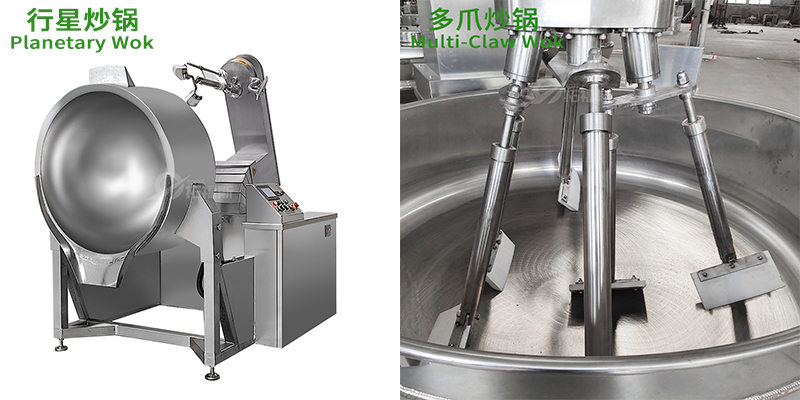
Planetary Wok: Hemispherical pot body, which has a larger heating area, can more effectively utilize thermal energy, improve the heating rate, and save energy. Under the same loading capacity, the hemispherical pot body has a deeper depth and a smaller cross-sectional area, so it occupies less floor space and saves space.
Multi-Claw Wok: Disc-shaped flat pot body.
Occurrence of Problems
The stirring shaft of the planetary wok is simpler than that of the multi-shaft wok, so there are fewer problem points, and the possibility of problems in the subsequent use process is lower.
Price
Under the same loading capacity and production capacity, the price of the planetary wok is lower than that of the multi-shaft wok.
More recommendations